

Is it time for a custom CRM?
Updated: Sep 22
Most companies we talk to still hesitate at the words "custom CRM". The hesitation is earned. For years a custom system meant a long project, a growing invoice, and a result that fit the process the consultants understood — not the one the team actually ran. "Don't reinvent the wheel" became the safe answer, and for a long time it was the right one.
The economics have changed. Here is what is different now, and why a custom CRM is a reasonable option for a 10–100 person company rather than a gamble.
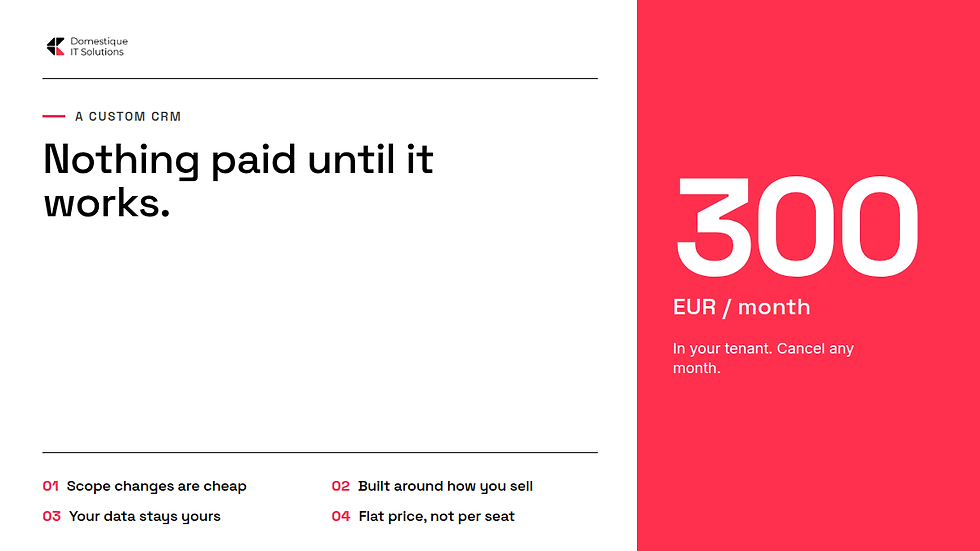
1. Scope changes are cheap
The expensive part of a custom project used to be the rework. A field in the wrong place, a stage the sales team never used, a report nobody asked for — each one was a change request with a price. Today changing the logic of a process takes hours, not weeks. When the team spots a mistake in week two, we fix it in week two.
2. You do not pay to find out whether it works
We build the CRM to your requirements at our risk. Nothing is paid until your team is using it and is happy with it. After that it is rented: a fixed, competitive monthly price that does not scale with headcount, deployed in your own Microsoft tenant or Azure, cancel any month. That price covers hosting, fixes, maintenance and small changes. There is no project budget to defend, and no invoice for the version that did not fit.
3. It fits the way you already sell
Off-the-shelf CRMs are built for an average sales process. Yours is probably not average. A broker's deal has different stages than a manufacturer's quote; a training company tracks groups and dates; a service firm tracks sites and contracts. A custom CRM is built around those objects and stages from the start — nothing to hide, rename or work around.
4. Your data stays yours
The app runs in your tenant. You decide how and when to access, report on, export or migrate the data. We keep the code and the reusable patterns; you own the data and use the app for as long as you rent it. If you ever stop, the data export and handover are part of the agreement, not a negotiation.
5. Flat price, not per seat
For a growing team, Dynamics 365, HubSpot or Salesforce licences are priced per user and can reach tens of thousands of euros a year. The monthly price is fixed and competitive — it does not scale with how many people use the app.
What we ask from you
One decision maker, the person who actually runs the pipeline, and one real example — a deal from first contact to invoice. From that we draft the app, build it, and show it working with your data before you decide anything.
If your sales process lives in email, Excel and a CRM nobody fills in, tell us about it. We will say whether a custom CRM makes sense, or whether one of our existing products fits better.


Comments